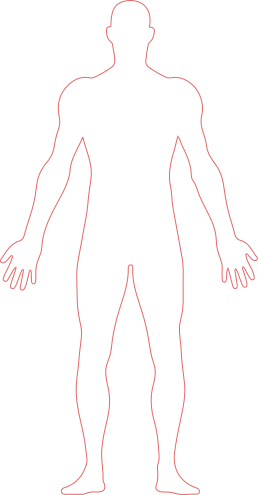
Click on the body parts or the list below to find out more about your pain and how physical therapy can help.
Patellar tendinopathy, sometimes called jumper’s knee, is an overuse condition affecting the tendon connecting the kneecap to the shin bone. It commonly causes pain at the front of the knee during jumping, running, squatting, or other activities that place high demands on the tendon.
How Physical Therapy Can Help:
Physical therapy focuses on progressive tendon loading to rebuild strength and improve the tendon’s ability to tolerate activity. Treatment may include isometric and progressive resistance exercises, activity modification, movement retraining, and a gradual return to running, jumping, and sport.
Total knee replacement is a surgical procedure in which damaged surfaces of the knee joint are replaced with artificial components, most commonly for advanced osteoarthritis. Rehabilitation is essential for restoring movement and function following surgery.
How Physical Therapy Can Help:
Physical therapy helps reduce stiffness, restore knee movement, rebuild strength, improve walking and balance, and regain independence with everyday activities. Rehabilitation is progressively advanced according to healing, functional goals, and the individual’s recovery.
The medial collateral ligament (MCL) and lateral collateral ligament (LCL) help stabilize the knee against side-to-side forces. Sprains occur when these ligaments are overstretched or torn, often during sporting injuries, falls, or direct impact to the knee.
How Physical Therapy Can Help:
Physical therapy helps restore knee mobility, strength, stability, and confidence following appropriate healing. Rehabilitation progresses from controlled strengthening and balance exercises to running, agility, and sport-specific training when appropriate.
The anterior cruciate ligament (ACL) and posterior cruciate ligament (PCL) are important stabilizers within the knee. Injuries can range from mild sprains to complete tears and may cause pain, swelling, instability, and difficulty returning to demanding activities.
How Physical Therapy Can Help:
Whether managed conservatively or surgically, physical therapy focuses on restoring knee motion, quadriceps and hamstring strength, balance, neuromuscular control, power, and functional stability. Later rehabilitation may incorporate running, jumping, landing, agility, and return-to-sport testing.
The menisci are C-shaped structures within the knee that help distribute load and contribute to joint stability. Meniscal injuries may occur suddenly during twisting or pivoting or develop gradually over time. Symptoms can include pain, swelling, clicking, catching, or restricted movement.
How Physical Therapy Can Help:
Many meniscal injuries can be managed successfully with rehabilitation. Physical therapy focuses on restoring knee mobility, strength, balance, and functional capacity while progressively increasing activity. Rehabilitation is also important following meniscal repair or other surgical procedures.
A quadriceps strain occurs when fibers within one or more of the muscles at the front of the thigh are overstretched or torn. It commonly occurs during sprinting, kicking, jumping, or sudden acceleration and may cause pain, weakness, swelling, or bruising.
How Physical Therapy Can Help:
Physical therapy progressively restores muscle strength, flexibility, and tolerance to load. Rehabilitation advances from controlled strengthening to higher-speed movements, running, jumping, and sport-specific exercises to safely return the patient to their previous level of activity.
A hamstring strain occurs when one or more of the muscles at the back of the thigh are overstretched or torn, commonly during sprinting, rapid acceleration, kicking, or sudden changes in movement.
How Physical Therapy Can Help:
Physical therapy uses progressive strengthening—particularly eccentric and lengthened-position hamstring loading—alongside mobility, trunk and hip strengthening, and a graded return to running. Later rehabilitation incorporates sprinting and sport-specific demands to reduce the risk of reinjury.
Knee bursitis occurs when one of the small fluid-filled sacs (bursae) surrounding the knee becomes irritated or inflamed. Depending on the bursa involved, pain and swelling may occur around the front, inside, or back of the knee.
How Physical Therapy Can Help:
Physical therapy helps identify and modify activities contributing to irritation while addressing strength, mobility, and movement impairments. Progressive exercise, education, and appropriate symptom-management strategies can help restore comfortable function and reduce recurrence.
Knee osteoarthritis is a condition involving changes to the cartilage, bone, and other structures within the knee joint. It may cause pain, stiffness, swelling, reduced mobility, and difficulty with activities such as walking, climbing stairs, or rising from a chair.
How Physical Therapy Can Help:
Exercise is a first-line treatment for knee osteoarthritis. Physical therapy uses individualized strengthening, aerobic exercise, mobility work, balance training, education, and activity modification to reduce pain and improve function. Appropriate rehabilitation can help patients remain active, maintain independence, and improve their overall quality of life.
Address
Phone
© 2026 Flexx Physiotherapy. All rights reserved.